In 1915 at the beginning of the war, Paolo Primo assumed his office of Chief of Stato Maggiore of the 1st Armed Corps in Verona. The family moved to Viareggio, both because the children had need of the sea (Alessandro and Nora) as well as because the restrictions for winter heating that would certainly come because of the war, it wasn’t the case to remain at Turin and instead we needed to find a milder climate. My mother very stoically lived first in a convent of sisters where it was not permitted to retire after 9 pm and the year afterward in an apartment in Piazza d’Azeglio, 10. There she remained until Paolo Primo came back from the war, and bought in San Remo the Villa Belrespiro in 1919. I was appointed Lieutenant in June 1915 and destined to the 27th Artillery campaign dislocated in Val Camonica. Paolino (Paolo Secondo) was with the 35th Artillery Campaign and with the grade of Captain on the Carso. Giorgio had entered the Military College in Rome. The sisters, in the residences already seen.
In the meantime Paolo Primo had been promoted to Lieutenant General and at the end of 1915 was designated to the Command of the 12th Division of Infantry, that was occupying the hills to the west of Gorizia, between which the well known Podgora. He placed his Command in the Castle of Spessa not far from Cormons and until the middle of 1916 kept that difficult and trying command. In those years the war was manifesting in its hardest aspects. The armies were entrenched and in those holes of dirt and mud the soldiers defended palm to palm every meter of terrain, subjected to the hardest and most massive bombardments that history remembers. The life in the trenches was exhausting and trying, and the morale was affected by heavy losses and forced stasis. Without which it should come out in an offensive profundity, violent preparations of artillery on the lines of narrow fronts followed by attacks with troops trained in hand-to-hand combat, were effected now here and there keeping the troops and commands in alarm and creating reasons for anxiety not to mention nervous exhaustion.
One of the points on the front that was most targeted for enemy attacks was then Podgora both because it was well identified and because there was an observatory on the plain of Gorizia, as well as because it constituted a trampoline for launching one of our actions against Gorizia itself. The tension on that front was however great and one needed nerves of steel to confront the psychoses of alarm that were there being step by step created.
Once late into the night, the very valorous General Tiscornia, Commander of the Pavia Brigade that with the Casale Brigade formed the 12th Division, telephoned Paolo Primo with an agitated voice to warn him that a strong group of Austrians, availing themselves of the dark, had infiltrated behind our lines in Podgora. According to the information received said group had bypassed a part of our first line creating active alarm.
Paolo Primo sought to calm General Tiscornia inviting him to gather some precise information about the force of the enemy group that had infiltrated and observing that, anyway, it was not the case to speak of bypassing since the bypassers were really the Austrians that found themselves behind our lines in a number certainly inferior to our troops garrisoned at the first line. Some hour or so after it was clarified that the group of Austrians who had caused alarm with their chatter behind our lines, were some Bosnians who wanted to desert and not meeting the enemy to surrender themselves to, had become disoriented and found themselves in a very embarrassing situation.
On the Castle of Spessa that, as I have said, was the seat of Paolo Primo’s Command, fell during a bombardment of large caliber a 305 mm grenade that did not go off that had landed in the foundations of the castle itself. Said grenade, then recovered and emptied of explosives was sent to Paolo Primo at the end of the war. It was placed at the entrance of the Villa Belrespiro where it remained as long as the villa was our property. When the villa was sold to the Minister of Agriculture, the Experimental Garden of Agriculture that had established its seat there had it removed.
Another time, still at Spessa, shrapnel from a grenade slashed Paolo Primo in the temple, although he had in that moment put on his helmet, and following its trajectory lodged itself in the wall against which he was leaning, detaching a marble frieze that fell at his feet; they were the heads of two little angels of graceful make that I saved in my own house on a placard of wood, attached to the wall.
During the summer of 1916 the Austrians launched a great offensive in Trentino with the objective of the Padana plain and the sea, cutting off our our army deployed from Carnia, to Isonzo and to Carso. General Cadorna, surprised by how our lines were moving back which had for some weeks made him fear the effective realization of the Austrian plan, hurried back to the Veneto flat lands three Armed Corps both to counter the enemy’s progress, as well as and especially to counterattack them, stop them, and reject them the moment in which they entered the plain. At the command of one of the Armed Corps Cadorna designated Paolo Primo although his grade was General of Division. This genius maneuver thought up by Cadorno according to the most brilliant dictates of strategy, was however the last page of a very dangerous situation and it is obvious that Cadorna chose the Commanders that gave him the most confidence of having military talents, of character and command, necessary for the difficult and arduous need.
The Austrian attack after its initial successes lost some of its bite and ability to penetrate since it was stopped before it had reached the plain and after a little while the Austrian Troops folded almost everywhere on their starting positions, pressed by our troops. The occasion to employ the Armed Forces in their entirety however did not present itself.
In an action of following the retreating enemy, Paolo II (Paolino) had the opportunity to distinguish himself; officer of Stato Maggiore under the command of the Armed Forces; he rejoined in a great hurry a squad of officers and soldiers and with them maintained contact with the enemy furnishing his commanding superiors with precious information. The action was conducted by him very brilliantly, enough to obtain for his valorous conduct a silver medal of military bravery with the following motivation:
“Major Paolo Ruggeri-Laderchi commanded in service in connection with the the command of the armed corps and the dependent troops on the front line, fulfilled his mandate charging continuously zones under active artillery and enemy rifle fire and contributed in maintaining the connections with the lateral armed forces, working energetically to reunite scattered soldiers and return them to the front. Scorning danger, animated by fervid enthusiasm, he was an example of untiring activity, of firmness and of courage, and, with intelligent zeal, carried notable help to the commend in every phase of the various actions.”
Plateau of Asiago, June-July 1916.
Paolo II, when the Second World War began, stayed in Berlin. He was then Counsel General of Italy at Dresden and he found himself with his family in that city when it was bombarded and raised to the ground by the Anglo-Americans. Having escaped miraculously with his whole family, after an anxious journey, stopped in Füsen in Tirolo also because there was found the family of the Thur and Taxis Princes with whom he was connected by a cordial friendship. He died unexpectedly at Füsen in 1945 from an infarction and was buried there.
In Berlin he married the Signorina Ilse Bishof and had two children: Alessandro II (born 1941) and Vera (born in 1943). Alessandro graduated in political science after having completed his work in an oil company in Nigeria is now at Eni. [an Italian oil company] Vera married the Marquis Paolo Imperiali di Francavilla and had a daughter Alessandra III (Sania, born in 1967). [Author’s Note (1970) – Alessandro married Paola Caroselli and a son Francesco Paolo born in 1970’s and a daughter Caterina born in 1972. Vera had another two daughters, Michela (born in 1969) and Elena (born in 1970) and a son Giacomo (born in 1973).]


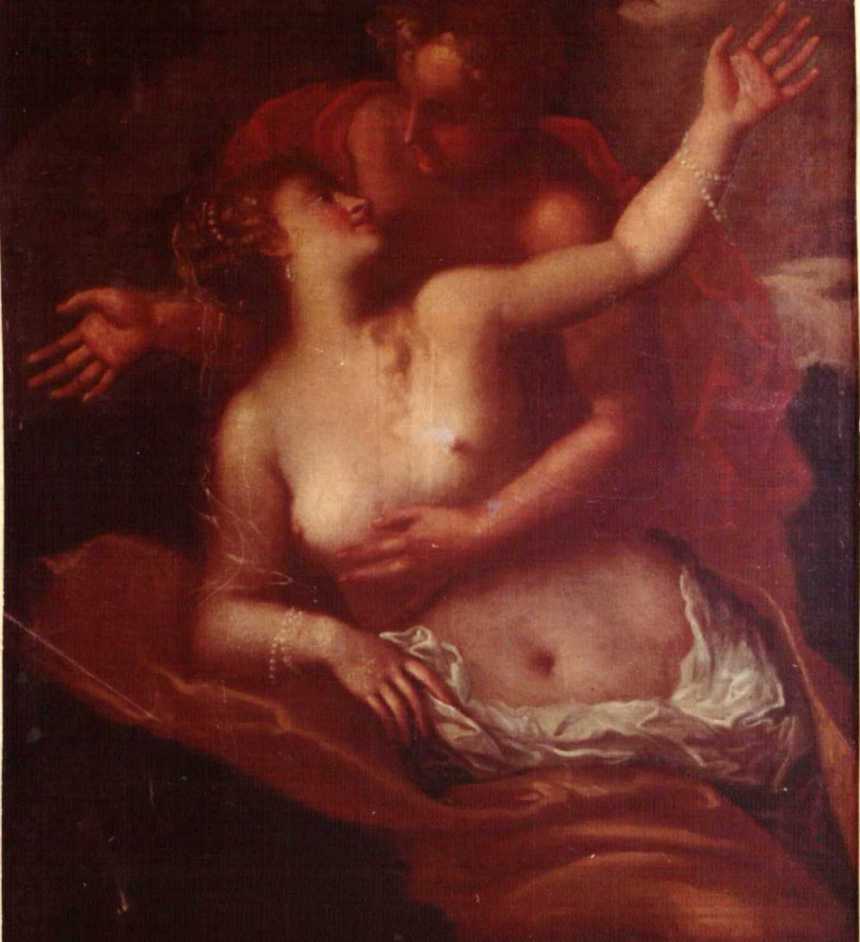
My father remained in the area the months of June and July in 1916; he lived at the Villa Trieste in the area of the Brenta and as usual ordered that the locales of the villa be adapted and curated for the use of the Command and of the officers. In the room in which he slept, the three doors that opened into the room, were ornamented above with beautifully made canvases fixed to the wall with stucco. One of these that portrayed “Love and Psyche” was especially admired by my father who had it in front of his eyes because it was basically in front of his bed, during the animated vigils of the thoughts of the grave responsibilities that loomed over him in those tragic moments for the fatherland. He ordered for this reason that a painter called by him make a copy of it for him to keep as a memory. The proprietor however of the villa (who I believe belonged to the Stigliano Column) on a visit while my father’s Command was staying there, desired rather that my father take the original, replacing it with the copy above the door. He wished this to be an homage to the personality of my father and a sign of recognition for how much he had planned ahead so that the villa could avoid undergoing damage by the occupying troops.
The canvas attributed to Tiepolo is currently in my house.
In the month of August in 1916 General Cadorna carried out the maneuver that brought the conquer of Gorizia. While the Austrians were still employed in tending their wounds brought back from the failed offensive in Trentino, Cadorna moved on Isonzo the troops gathered in the Veneto flatlands for the counter-offensive purposes of which I have spoken. At first the Divisions that constituted the Armed Corps of Paolo Primo passed to the direct command of General Capello therefrom, in the course of battle some of these were regrouped in an Armed Corps (the 8th) of which Paolo Primo assumed the command with a seat at Valisella in the Villa Codelli.
Paolo Primo, who from September 1915 to April 1916 had faced with the 12th Division deployed on the Podgora, the City of Gorizia, so had the venture of conquering the city with the troops of his Armed Corps and was the first General of the Armed Forces to enter into the redeemed city.
The actions that followed the conquer of Gorizia were very bloody, and the battle little by little stabilized employing the command in the difficult operation of refurnishing the troops with materials on the other side of the Isonzo, in the organization of the lines, in the advancement of the troops. In the month of November Paolo Primo received at Villa Codelli the visit of D’Annunzio accompanied by my brother Paolino (Paolo II) who was Major of Major State. D’Annunzio had participated in the battle of the Veliki Krib with great abandon and illuminated courage.
Another noteworthy event was Paolo Primo’s meeting with Locchi, poet and author of “Sagra di Santa Gorizia”. One day that Paolo Primo had returned to the line for a visit, he saw a soldier who was running at a gallop on horseback on a track of street from the very hard bottom. When Paolo Primo rejoined the soldier he stopped to reprove him for galloping on the hard bottom of the street, however, in the course of the conversation he learned that that soldier had a generous and enthusiastic spirit. Locchi, in fact a postal officer, had the “assimilated” grade of Lieutenant and did not have to personally carry the post to the soldiers on the line. Locchi, instead, every day, carrying the poster bag with a shoulder strap, ran on horseback the tracks that, even if hit by enemy artillery, were transitable, therefrom by feet, he ran the trenches of the front line to personally distribute the post. Paolo Primo on whom Locchi depended, admiring of this behavior invited him to the cafeteria of the Armed corps and so began his numerous visits which gave to Paolo Primo the way to discover the high poetic vein of Locchi and his sensitive and proud soul. Locchi at first joked because he believed it was above his capabilities to write a poem on an episode of this epic, but then one day he brought Paolo Primo the “Sagra di Santa Gorizia.” Disgracefully this is one of the very few, if not the only work of Locchi who, a little after that, destined for Albania, he found death by torpedoing, in his transversal of the Adriatic.

As often befalls poets, and painters, Paolo Primo was the determining element of the poem by Locchi for the incitement that came from him, so that also on this occasion Paolo Primo showed himself to be a Patron.
It was in this stretch of time (the end of 1916) that Paolo Primo obtained the promotion to General of the Armed Corps (he had until then kept that command without having the grade) and the Cross of and Officer of the Military Order of Savoia, with the following motivation:
“Which Division Commander directed with intelligence and experience the operations of his own great unity in the offensive actions from October to December 1915 against the hills to the west of Gorizia. Which commander of the Armed Corps participated in the taking of Gorizia, and knew then to maintain it, in very difficult conditions, on the left of the Isonzo, in immediate contact with the enemy, tearing from him with indomitable constance, powerful positions of defence.
(October 1915 – November 1916)”.
At the end of December 1916, Paolo Primo received the post of representing General Cadorna in the political-military Mission that, with Minister Scialoia, gathered in Russia at St. Petersburg for an inter-ally conference. Representing France, the ex President Dumergue and the General Castelnau; England, Lord Milner and General Wilson; Russia, the Minister of Foreign Affairs Pokrovsky and General Gurko. Composing the Italian military mission: Minister Scialoia, the diplomat Aldrovandi, Paolo Primo, the Lieutenant Colonel of Stato Maggiore Ugo Callero (who during the Second World War had a top-level role), Paolo II, then Major of Stato Maggiore.


After a journey with stops in Paris and then in London, they embarked upon an English war ship then took a secret route, parting from Oban at the port of Kola on the Murman coast; traveling from there by train over 5 days until reaching St. Petersburg.
At St. Petersburg they had sessions scheduled to take place among Allies on the political developments and military futures, and all the missions took part in a reception offered by the Tzar. On that occasion there was taken a photograph with the Tzar encircled by the members of the various missions; in this it is easy to recognize Paolo Primo and Paolo II. This photograph is published in the Book by Aldrovandi Diplomatic War that speaks of the Conference of St. Petersburg of 1916 citing as well the name of my father and of Paolino.
Around the end of their stay in Russia, Paolo Primo was struck by a serious form of bronchitis that constrained him in bed with a high temperature. When the moment to embark came in the meantime, the question was presented wether Paolo Primo should depart as well, having just begun his recovery. It was full winter and the route was that of the Arctic Ocean to avoid the pitfalls of German Submarines. But to renounce that departure meant a long stay in Russia, without any security concerning when he would be able to effect a return voyage. Paolo Primo however decided to depart with the group; a special little mask covered his mouth, necessary so that the cold air wouldn’t go straight into his lungs, but very annoying to breathe. With this accoutrement he could return to Italy with damages and consequences. Paolo II, remained instead in Russia at the dependence of General Romei.
In London, during the return voyage, Paolo Primo was awarded with the commendation of the Order of Bath, the noted KCB that gave him the right to use the prefix “Sir”. In addition during his stay at London he visited the daughter Ina of my mother’s aunt, Olga Cnachrine. Ina had married Lord Worsdale. He found a person by then completely anglicised and with few memories of her family of origin.
Returning to the fatherland, General Cadorna entrusted to Paolo Primo the Command of the 9th Armed Forces. This was extended on a vast front in the high mountains and comprised the Col di Lana, the Marmolada, the Colbricon, etc. [tr: names of mountains] Paolo Primo, assumed command of it in the March of 1917 and he kept it in that zone until November of the same year — when, due to the discomfiture of Caporetto came the retreat of the Fourth Armed and therefore of his Armed Force on the line of the Piave. From March to November 1917 were effected various actions among which brought the conquering of Cima Sief on Col di Lana preceded by the explosion of a large landmine, that upset the whole summit and those of high mountaineering on the three summits of Lavaredo and on the Marmolada.
Paolo Primo’s command was established in Val Cardevole in the immediate vicinity of the Lake of Alleghe which Mount Civetta overhangs.
In the first days of November 1917, following the ominous days of Caporetto, the Fourth Armed had the order to fall back on the Piave. The Armed Force of Paolo Primo presided over the junction of the Tomba and the Monfenera between the river Piave and the degrading hills on which it sits almost at a right angle. This tract of our line constituted the hinge between the plain and the mountains tract that leaned on Monte Pertica and of Mount Grappa; it was however the most delicate of the entire front. The Austro-Germans had certainly repeated the maneuver that they had had much success with at Caporetta which was to break through the Tomba and Monfenera to outflank both our line on the plain as well as ours on the mountain. General Diaz, Supreme Commander, gave to Paolo Primo some directives that left him some great responsibilities: “To defend the tract entrusted to the Armed Force, for as long as possible; if it happens that he cannot hold the line, to give to the Supreme Commander a pre-warning of at least three days so that the retreat of the entire front could be gradually carried out from the south, where it joined the sea.”


These being some admissible directives, being given to a Commander of Great Unity, there is not one who does not see how these would fall upon Paolo Primo the fault of a general retreat of our front should things go badly and instead to make rise again to the Supreme Command the merit of having resisted on the Piave when things went badly.
Certainly the responsibility that Paolo Primo assumed in that moment was tremendous. It is necessary to think that more than half of our Army had been hit and taken out of combat, that our undoing had been unfortunately complete and that it was not limited to the abandoned terrain of the fatherland, to the hundreds of thousands of prisoners, to the materials of all types especially of lost artillery, but extended to the morale of the troops that were left sapped, to the distrust that had invaded the commanders, to the careless internal politics on the front. Paolo Primo was really the Man of the Hour. He had the faith of his troops that had effected the retreat in perfect discipline and of whom he knew the morale was still intact; he was secure of his dependents that he knew one by one and the soul of whom he had plumbed more times; he was secure in himself, in his capacity to resist fatigue, to keep his nerves strong, to maintain his capacity for judgment and for decisions in the serious moments but, more than anything else, he was convinced that on the Piave it was necessary to hold at all costs if one wished to avoid the debacle, not to lose what until then had been obtained with much blood, to maintain its own role among the Allied Powers, to show that Caporetto had been one unfortunate episode and that Italy with its army was still standing to defend its borders and its rights.
With this character Paolo Primo set about this great work.
In the meantime the enemy advanced rapidly pointing a whip of its forces on the directress: Valdobbiadene, Tomba and Monfenera. The battle, among the most fierce, quickly flared up in that area; it lasted days and nights; the lines of defense were attacked and then occupied with counterattacks, were lost and then retaken again. The enemy offensive seemed inexhaustible, the terrain was plowed by the continuous concentrations of artillery. In this climate it seemed to those among the highest commanders that “holding” still would have been a folly and would compromise the entire outcome of the war if, in place of a new order to fall back and on lines much further back and stronger, they had a “breaking point” on the front in the most dangerous location for the entire army. To express their thinking and to divide their responsibilities with those of Paolo Primo, his Division Commanders had a meeting at his his Command. Each one expressed his own persuasion. Paolo Primo heard them all, made a computation of the forces at his disposal and decided. “On the Tomba and Monfenera we must fight till the bitter end. No retreat would take place.” He reorganized the forces. He substituted worn-out and untrustworthy commanders. He instilled faithfulness, he urged them, take the situation into his own hands. After a battle of a month the enemy gave up its plans of breaking through and the battle settled along the lines kept with the force of the desperation and the pride of a race that was finding again in itself the power of their ancestry.
The socialist Minister Leonida Bissolati, taking part in the government of that time, wanted to visit the Command and the troops of the armed forces and to he expressed: “Here of gentlemen, not only was Italy saved, but something more: the honor of Italy; and this I tell you with the thanksgiving of the whole Country, as Minister, as soldier, as an Italian.”
Paolo Primo had on that occasion the Commendation of the Military Order of Savoia with the motivation that said:
“He directed in an admirable way the difficult retreat of his Armed Force of the high Cordevole and from the high Cismoon succeeding in carrying to completion with his entire artillery and all his materials on the new front. He defended with his troops in fierce combat the head of Ponte di Vidor, the Straits of Quero, the heights of Monfenera and of the Tomba despite the rudimentary character of their defensive systemization and succeeded in impeding the enemy from entering the base of the val Piave on the plain in the moment in which an eruption in that direction would have been most dangerous for the entire Army.” Cadore Front, Trentino and Tomba Piave. November-December 1917.”
The original Brevet of concession of this highest decoration is found at the Castle Sforzesco of Milan in the Museum of the Revolution and Museum of War, together with the photograph of Paolo Primo.
There is no need to stop for long on this period of the Command exercised by Paolo Primo in war, to measure all the importance. In that same period of the strenuous resistance on the Tomba and Monfenera all eyes were fixed on him. Beginning with His Majesty the King who came to attend news every day at the Command in Asolo, he was visited by French and English military chiefs, by senators and by deputies, by political men and by colleagues, by journalists, by fans. He in those days was the man of the “Resistance,” the man on whom depended not only the immediate fate of Italy, but also the future.
In the time around the years of the war 1915-1918, Paolo Primo was protagonist, maker, and animator of two events for Italy of basic importance and that constituted two hinges for the future: the taking of Gorizia, the resistance on the Tomba and Monfenera. These two episodes alone placed him among the praiseworthy leaders of the Fatherland and they point to the memory, the recognition, and to the esteem of future generations. We will see now, as it was precisely this that nourished them.
With the end of the year of 1917, the enemy halted on the Piave, the Armed Force commanded by Paolo Primo was substituted in the line by French and English troops. With his troops gathered on the plain, there began a well-deserved rest for all. But this did not last long: on the front of Grappa things were not going well. The Armed Force of General di Giorgio had ceded territory to pursue the enemy; there had been necessary serious sanctions; the morale of the troops was for this reason low. Paolo Primo was called to heal this grave and dangerous situation for the place on the front where it was being produced. He substituted the General di Giorgio, renouncing his rest period and only asked to have again on that tract of the front the troops that had been dispensed by him in the glorious days of the Tomba and of Monfenera, as they were completing their turn for rest. The Command of the Armed Force was placed at Rosà at the Villa Dolfin and Paolo Primo began the work of giving back to the tract of the front entrusted to him consistency and security.
In the meantime from the new Supreme Command came news of new names in the highest grade of the army: they had to be made Army Generals or Generals of the Armed Forces. Due to the precedents of Paolo Primo it was doubtful that he would be made one of the new generals of the Army; at the Armed Forces mess hall officials from the Supreme Command that brought the news, toasted with the officers of the Command my father for his deserved appointment.
In the climate that came at the end of January 1918 the news of the appointment to Commander of an Armada of the Division General Pennella; moreover he had been designated to command the Armada of which the Armed Force of Paolo Primo played a part, substituting him with General di Robillant.
In front of this provision, Paolo Primo assumed a precise and clear position. He asked to be exonerated from his command and designated to another post. In support of his request he adduced:
- That a high command like his could be accomplished with success and security, only if the person of the commander was surrounded by a halo of esteem and of confidence, that the fact of having left into the promotion to General of the Armada placed in discussion;
- That he would be dependent on someone from an inferior grade (because of the Division General) with grave damage to the prestige of the hierarchy, and subversion to the basic principles on which was founded his army career.
In truth the appointment to commander of an Armada of Division General Pennella was a political matter since it had been desired by the Honorable Nitti, then President of the Council. The Supreme Command, partly because it was weak and supine to the desires of the political party, to which instead the predecessor Supreme Commander, General Cadorna, had kept his head with great dignity and firmness; partly because he distancing of Paolo Primo favored the ambitious career aims of the new generals brought to the limelight by the catastrophe of Caporetto (Giardino and Badoglio); the Supreme Command in sum, assumed a negative attachment, adducing that the choice of Armada generals could come apart from grade (for example as the Pope could appoint the Cardinals) which while it was a fact in the Army, had never been verified. In the specific case then there were some more evident incongruencies and injustices, General Pennella not having any other title of wealth in high grades, to be asserted.
The Supreme Command reproved Paolo Primo, and the Minister of War also echoed this, “for having given proof of inopportune susceptibility and showing how he did not know how to make silent personal resentments before the supreme interests of the Army in war and in the grave exigencies of the moment.”
From all the correspondence of the time from Paolo Primo to my mother, from his notes, from the relations successively written by him in explanation of his actions, it seems in an unequivocal way that instead the thinking which had motivated Paolo Primo’s vision had been, as he himself writes in the following passage: “I cannot serve a fine noble who does not know how to guard his dignity, his prestige, his moral integrity. When grave problems loom and the general interests are in play, one does not have the right to remain silent, one does not have the right to avoid through a sterile external appearance to avoid the fruitful effort from which may emerge the norm of a superior discipline. One of the most important requirements of the general is his prestige, the most important of his qualities his character… I left the Command when my shaken prestige could have done harm to the service.”
Paolo Primo’s request to be exonerated by the Command of the Armed Forces, lay there at the Supreme Command for several days; at base it was not easy to act against a General of the Armed Forces who had well merited [the rewarding of that position] from the Fatherland. At the same time the Supreme Command did not want to use the only means they had at their disposition to truncate the distressing situation, that is, not to grant Paolo Primo’s request and to order him to remain at his post. Evidently so, while this would place Paolo Primo in the condition where he must obey, he would be able to guard his honor. Another path was chosen instead, that of inviting him to retract the request. There is none who does not see how that invitation lent itself to tame Paolo Primo for a lack of character.
Paolo Primo, finding out that the Supreme Command would not have given him any regard and thus fully aware of the consequences of his actions, did not accept the invitation to retract his demand. The sense of necessity which he conceived, the prestige of the level to which he intended, the love of Fatherland which he felt, counseled him to not put his personal advantage first. His Majesty the King came to his Command to persuade him to retract the demand and asked him why he wanted to “show his nails.” [tr. “bare his teeth”] Paolo Primo responded that his nails were not gloves which he could put on and take off at his pleasure and that His Majesty Himself had been well pleased that he had these nails when, anxious, he had come to find him at the Command during the epic days of the Tomba and of the Monfenera.
The 3rd of March, 1918, Paolo Primo left his command to return home. There he received the “punitive” document of his forced retirement.
Paolo Primo was then 56 years old and moreover the provision was illegal since by law being put into retirement could not happen before the age of 62. In fact several years after, the provision of forced retirement was annulled by the Fourth Section of the State Council to which Paolo Primo had recourse.
As described it impeded Paolo Primo from finding himself among the chief officers at the moment of the Victory, which came only six months after the narrated facts and to which he had made a very valid contribution. It cannot be left out, rather it is more certain than ever that if he listened to his benefit, he would have finished the war at the Command of an Armada and for this he would have become Marshal of Italy and would have been awarded with a noble title.
His gesture was not understood by all; some maintained that he should have remained at his post, citing the precedent of the Russian General Kuropatkine who during the Russo-Japanese war of 1904-1905, exonerated by the commander in chief for having lost some battles, asked to remain in the subcommand and having obtained this, worked tirelessly to return to his flags the honor of Victory. Here it is necessary to observe however that General Kuropatkine was a “defeated” general, having lost a good three large battles, while Paolo Primo was a “victorious” general who could count among his activity the taking of Gorizia and the resistance on the Tomba and Monefenera.
After long reflection and after having much read that which Paolo Primo wrote during that time and during the entire war, I have become convinced that Paolo Primo’s mode of action was in absolute harmony with the conduct by which he carried himself during his entire existence, that would not admit compromises and that made his CHARACTER the principle element of his life. It is in doubt that his intentions were pure; however, when the purity of his intentions has not been recognized by everyone, rises the question of whether pride had a part to play.
On the occasion of his retirement Paolo Primo received from the officers of the Command of the Armed Force, a writing plate of solid silver with which was incorporated a medal in gold depicting the wolf of Rome (the 9th Armed Corps was the Armed Corps of Rome) with the following wording:
“The Officers of the 9th Armed Force – to His Excellency the General – Count Paolo Ruggeri-Laderchi – to express – the highest esteem, the affection and gratitude – to the Chief who knew to guide them – with a steady hand, with an illuminated mind – in the most arduous ordeals – to Victory, to the salvation of the Patria.” War Zone, February 1918.

So, undeservedly, ended the military career of Paolo Primo. At times, he is remembered for flattering aspects and other times in less favorable moments; they are often discussed. His personality was too brilliant, impetuous, intransigent, to be accepted without comments. For some he was an ideal boss, for others a person who presumed too much of himself. The fact of his being healthy, handsome, cultured, brilliant, secure in himself, aristocratic, well-healed, distinguished and, in war, fortunate, was reason for envy and opposition. In the critical moment he was not used to any regard, rather it raged against him. One way to save his susceptibility, even if it is retained as excessive and presumptuous, could be easily found and instead was applied against him a procedure of absolute exception, resulting then in injustice, deliberately acrid and punishing.
One of the aspects under which he is often seen, is described with a certain vivacity, but also with intolerance, in an article by Tito A. Spagnol in the newspaper Il Mondo of September 3, 1963. The author, who in that time period of the First World War was a soldier of the Genius and took part in the squadron for telephonic connections, so writes:
“Having returned to Udine, our squadron took up its usual routine, interspersed at not very frequent displacements on occasion of some important action, such as that with the offensive on the front of Gorizia to which followed the conquest of the city, in the course of which we went to instal our equipment at the Command of the 6th Army Corps (the author errs: it was the 8th) in a beautiful villa in Valisella in the zone behind the Podgora, in service of connection, that time.
“If I remember well, General Ruggeri-Laderchi was commanding the 6th Army Corps, a handsome man with a powerful and aristocratic air, that had not ceded to the fashion of the generals dressed with soldier’s clothes, but who always wore his official uniform, with the little ribbons of all his decorations, ironed every day. He was not polite to me and not because he walked around dressed dapperly two steps from the Podgora, from which came up to there tremendous wafts of the many cadavers which the grenades and the bombardments continuously turned out of their graves (is there someone still who remembers the clay of the Podgora smeared with human flesh and its few oak stumps, black, all that was left of a flourishing bush?) which thing had had its own meaning, maybe D’Annunziano, but consonant with the spirit of the time: I did not like him for his voice, for the way he spoke like an actor, like those actors who continue to speak as if they were always on the stage and who listen to themselves pleased by their perfect diction. He got on my nerves …. (omitted). Apart from this, he was a good general and if I remember him it was only his lection that, at least for me, asked me to draw on the tolerance that the weaknesses of others deserve.”
The impressions are …. Impressions, and it is not my intention to discuss them with the esteemed journalist Spagnol who then, having given it a good reading, said nothing very bad except to unveil the left-handed plot by which he was enmired.
Of another tenor is that which General Vico Laderchi wrote about him, which so discusses Paolo Primo:
“He has all the qualities of a true soldier, but for his balanced health and for the nobility of his nature, as for his decommitted diplomatic roles, he is devoid of military-esque attachments.
“Tall, handsome, distinguished, secure in himself, fortunate, he appears right away, anywhere and always, a CHIEF. He appears this way even if he doesn’t have it or when he doesn’t have reason to be that way. And this, given human envy, harmed him that time. But it is for that fact of his calm and courage, for his rapidity of conception and promptness of decision, for constant clearness of concepts and simplicity of dispositions, for confidence in himself and love of responsibility, for ease and fervor of eloquence, for disdain of useless particulars and for happy intuition of those essentials, for his strong ascendancy over his inferiors, for the sacred fire that hourly renews his spirit, in sum: for science, art, praxis, health, character, fortune, he possessed the elect qualities of a great Chief.
“He is courteous and affable with everyone, frank and serene with his superiors. Affectionate and paternal with his soldiers; he keeps himself in touch, he entertains them, seeks out their needs, he has for them and demonstrates for them the maximum care. He is severe, but just. Generous, he can be indulgent, never weak. He is inexorable with the neglectful, with the hesitant, with the windbags, with the useless ones.
“He does not drink wine. He does not smoke. He eats frugally. He does not play cards.
“Tireless, he works easily twenty hours every 24. He sleeps when he wants. He rests by changing activities.
“In life his every activity is addressed to the best fates of the binomial: Fatherland-Family. In war, ‘Age quod agis’ is one of his maxims. He does not occupy himself with anything but the war.
“His success has always until now crowned his actions in war. No unpleasant accident has ever happened in the departments of his dependents. He possess a high sense of dignity, he retains the necessity of prestige to be the highest. Difficulties, he leaps over them. At the post of his Command can be read the maxims, ‘With a burden comes strength,’ ‘Obstacles are the weaknesses of the will,’ ‘Where there’s a will there’s a way,’ ‘It’s never too late to go even further.’ And he applied the concepts that these expressed and had them applied.’
“He is esteemed by the strong, by the useful, and by the honest. He was unbearable to the weak, to the incapable, to the envious, and to the sly.”
 The Ruggeri-Laderchi Family