I have dashed off up until here the news regarding the ancestors of my father, Paolo Primo Ruggeri-Laderchi and of my mother Alessandra Staël Holstein. Now it is up to me to give news on more recent times, that is on the life and events of my Father and of my Mother. I promise myself to discuss things and doings in the most objective manner possible, but since the exposition will be the fruit of my personal impressions and of the way in which I have interpreted things and doings, maybe other members of my family record them under a different light and under different profiles. The substantial things however can not differ also because before writing, I always asked my mother’s opinion who up until the age of 96 passed the summer months with me and the winter months with my sister Nora Klein in California in the Villa which her husband had constructed in Portola Valley a hundred kilometers from San Francisco.
My mother Baroness Alessandra Staël Holstein died in Portola Valley, California, the 10th of February 1969. Her body was transported to Italy and now rests in the tomb of her husband in the Cemetery of Mouth of San Remo. The tomb is on the immediate left as you enter from the main gate.
As has been seen, Paolo Primo married his first wife in 1886, Elena Vetchinine by whom he had three children:
Paolo II (Paolino “little Paul”) 1887;
Caterina (Rina) 1888;
Elena (Lola) 1889.
In 1890, Elena died and in 1895 Paolo Primo remarried to Alessandra Staël Holstein by whom he had five children:
Cesare II (Cesarino “Little Caesar”) 1896;
Giorgio II 1899;
Olga 1909;
Alessandro I 1910;
Eleonora (Nora) 1912.
Paolo Primo remained therefore a widower for about 5 years. He kept his three children still at a tender age near himself, providing for them the surveillance with an instructor, the Signorina Bicchierai Olga, who was excellent and affectionate with the children.
The marriage with Alessandra Staël Holstein was celebrated in Russia at Voronezh in the Orthodox rite. Paolo Primo was dressed in the Italian uniform; this happened the 28th of August, 1895. They overcame sundry obstacles to marry one another: the fact that he was a widower and intimate with the relatives of his first wife who had lands next to the Staël Holstein estates; the fact that he already had three children and they were all still at a tender age; the fact that he was a foreigner. Everyone however recognized that my mother married a handsome man, while nourishing reservations concerning my father’s authoritative character and my father’s jealousy.
My mother came to Italy after a brief honeymoon and the first city in which she lived, because it was my father’s garrison, was Milan. At that time she did not know a single word of Italian and her acclimatization was very difficult. At home, other than the children, Paolino (Paolo II), Rina and Lola lived temporarily, as well as Grandfather Cesare I with Grandmother Rina and Aunt Giulia. She had to meet all of them and establish affectionate relationships with them and at the same time learn Italian. It is also worth noting that the life in Russia of a family of the type of my mother, international by ancestry and by habits, was very different from that of my father who led a very simple life, conforming to the standard of living for Italian families at the end of the 1800s, that is of an Italy just having experienced the miracle of its Independence and in throes of political, economic, and social problems.


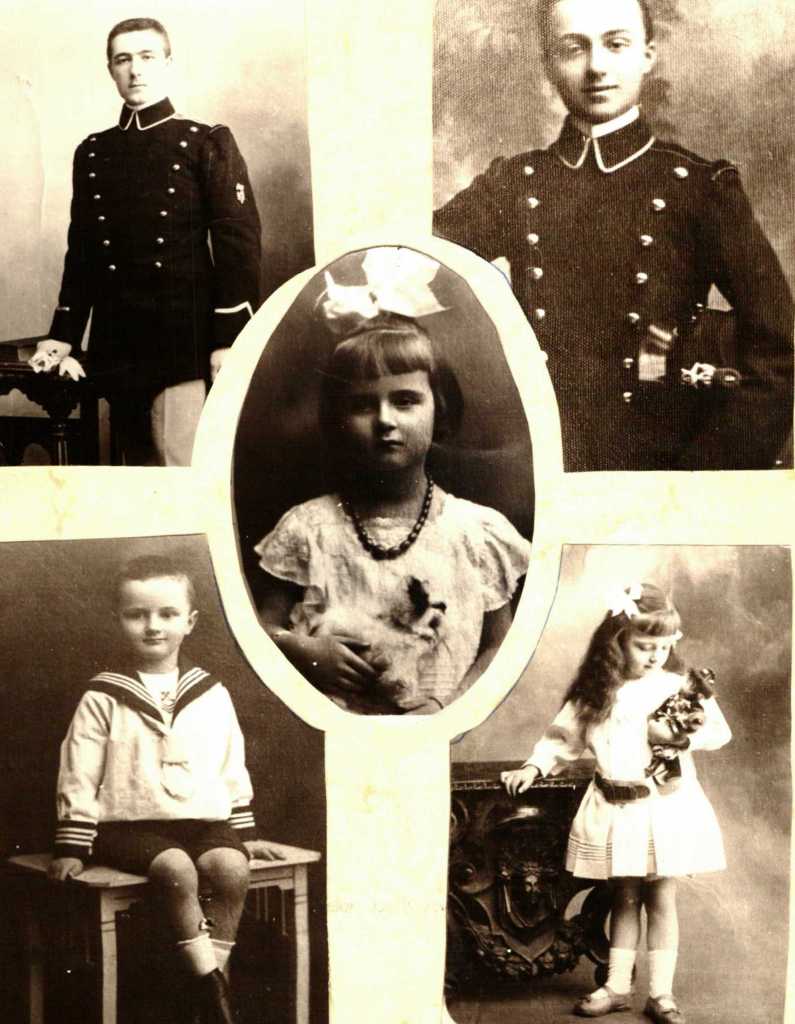
My mother furthermore in the last years of her life as an adolescent, had been a bit spoiled. From her aunt, Canchrine, she had inherited money and a property in Bessarabia, such that she had already enjoyed the use of of notable sums which she spent with generosity and indifference. Having moved she found herself transported suddenly into an environment where money had a very great value, was spent parsimoniously and was administered with much judgment and some rigidity by my father.
Difference in habits, ignorance of the language, unusual beginning to married life in a family already formed and already numerous, renders much more worth the facility of adaptation of my Mother who very quickly learned to carry herself in such a manner, united and compact, during the long years of her life.
The lodging in Milan where they began their married life was on Via Spiga, now the elegant center. A little garden looked out on the Naviglio which today has disappeared because it is totally covered over to make way for a street.
Signorina Olga Bicchierai, governess of the children, had returned to Florence and in her place was assumed Signorina Luisa Barsanti, 20 years old with a master’s diploma, having just recently left the convent. Signorina Luisa or “Sisina,” as I called her when I was a child, played an important role in our family as a governess to all of us children and remained in our house until her death at around 55 years of age.


We will have occasion to meet them anew with her following.
The stay at Milan lasted little because Paolo Primo was destined to Rome to the Stato Maggiore of the Army. They took a house on Via Genova, a cross street of Via Nazionale a short distance from the Ministry of War. In that house I was born the 30th of August, 1896. I was baptized in the Church of San Vitale, a beautiful ancient church on Via Nazionale.
After a few months’ stay in Rome there was presented to Paolo Primo, but especially to my mother, the need to make an important decision in a conflict of feelings, of necessity, and of love. My father had obtained the flattery and important post of Military Adept in the service of the Royal Ambassador of Italy in Constantinople and needed to leave for his post as soon as possible. His new destination was not tranquill due to the insurrection of Crete and France. England, Russia, Austria, Germany, and Italy had assumed the task of reorganizing there the Turkish Gendarmerie. The military adepts of the respective nations needed however to pass an undetermined period in Canea, capital of Crete. These were not the circumstances under which to take the family abroad, neither was it the time to refuse a post of great importance to my father’s military career. The problem that presented itself therefore to my parents had multiple aspects: would my mother follow her husband, entrusting me to the care of a wet-nurse and of my grandmother Rina, or rather, would she remain in Italy to continue raising me? Given that I was nursed by my mother, would I be the only one they took with them, simplifying many things by leaving in Italy Paolino, Rina, and Lola, always in the care of their paternal grandmother, or should I rather remain in Italy with my other siblings? There is no one who could not see the dilemma and its human and affective aspects.
One thing was decided right away: my mother would follow my father. Then they discussed me; to take me with them would have constituted a differentiation that my mother did not want to make in regards to the other children; I was therefore entrusted to a wet nurse and to my grandmother, and my mother left with my father. I understand that for her, leaving me was a an act of great sacrifice and pain.
This decision was often discussed in the family and also with strangers, when they were presented with analogous situations. Naturally the opinions were discordant. Some thought that my mother should not have left with her husband, but remain with the the nursing baby, others that instead she had done well. It is necessary above all to keep present the special situation of my mother: still a foreigner in Italy, and especially to keep in mind what a great material and affective ascendancy that Paolo Primo exercised and always exercised over my mother. Another example of this ascendancy, determinant in another very painful and serious situation, was when my brother Giorgio II died at 17, who drowned while taking a swim in the Tiber. My mother was staying in Voronezh with the younger children, Alessandro I and Nora. It was during the First World War and Paolo Primo was commanding the Eight Armed Corps with his own Command at Valisella on the front of Gorizia. I was Lieutenant on the Adamello; Paolino was Captain on the Carso. Because of his Command and military operations in progress, he could not absent himself. Paolino was however charged to returned to Rome for the search operations for the body of my poor little brother drowned in the river. My mother instead at the desire of Paolo Primo, entrusting the little ones to Signorina Luisa, returned to the zone of action near him, and remained there until the poor body of Giorgio I was found, recovered from the Tiber, and was buried at the Cemetery of the Verano, in Rome.
I cited these two examples because they illuminate and characterize, both the character of Paolo Primo, as well as the character of my mother, and give an exact definition of the feelings that had imprinted their marriage. It appears to me in fact that it can be deducted;
- That Paolo Primo had a great ascendancy over my mother, ascendancy which he always had with his children as well, through the force of decision that issued from him, for the energy of his character, for the faith that he knew to inspire;
- That my mother, accomplishing the great sacrifice of leaving her first-born when he could have come with her, bears witness to a line of conduct that she always kept and then, of considering as entirely equal to her both her children, and those of her husband, and of doing nothing that could differentiate in her heart and in her deeds, the ones from the others. The affection so given by my mother was fully paid back by all the children: Paolino (Paolo II) was unconditionally devoted to my mother and never wanted to say, or for anyone else to say, that she was not his real mother; Lola pleased my mother on her deathbed, who in fact had assisted her and closed her eyes to her in Vence, France where she had retired after the Russian Revolution; Rina, who actually lived in Paris, France, maintained with my mother an affectionate correspondence and spent a period of some weeks every year with her at San Remo.
Paolo Primo and my mother’s stay in Crete lasted about a year; he was highly praised both by his Italian superiors, as well by members of the allied missions for his capacity, for his tact, for his lordly and courtly manner of treating his Italian colleagues and those of other nations.
There he earned a silver medal of Military Valor with the following justification:
“Setting forth towards a serious danger to his life, he effectively took part in quelling the mutiny of 40 Turkish gendarmes who were actively firing from the barracks, and with his energetic demeanor avoided grave consequences succeeding in preventing the Italian sailors, who had rushed there to re-establish order, exasperated by the wounds received by one of their companions, from bursting into the rioters’ dorms.” Canea, Candia, March 2 1897.
It is necessary to note that in that period the Officials decorated with the medal of military valor, were very few, those who received the medal for acts of arms from 1866 and 1870 being already dead, and there were only a few who received medals of valor during the war of Abyssinia that was in progress.
When Paolo Primo returned to Italy, he had a very brilliant period both due to the decoration of valor that he had earned, as well as due to his having written a book of military politics entitled: L’Europa Attuale e la Prossima Guerra (“The Actual Europe and the Next War”) which was translated into French and had favorable reviews in various Italian and French newspapers.
In 1896, Paolo Primo prepared everything to legally add to the surname Ruggeri that of Laderchi. The descendents of the Laderchis from our branch had become extinct and the few Laderchis from the other branches authorized without difficulty an official as truly distinguished as Paolo Primo to carry also the name of Laderchi.
Paolo Primo had also prepared everything necessary to have pass to the Ruggeri Laderchis the title of Count which had been carried for many years and with much decoration by the Laderchis from whom he was a direct descendant. Now it happened that, due to fortunate circumstances, the Ministry of the Royal House, obeyed the Ministry of War in signing, the ministry that had had King Umberto I sign the decree of conferral of the silver medal of bravery, and brought to the King the decree of the conferral of the title of Count to Paolo Ruggeri-Laderchi. When the King learned that the document was concerning the same person to whom he had just conferred the medal of valor, he wished the title of count be given to Paolo Ruggeri-Laderchi by “Motu Proprio,” which aside from being of great moral value, was a new testimony of the sovereign’s benevolence.
The Decree of concession by Motu Proprio says:
“Umberto I by the grace of God and the will of the Nation, King of Italy; It pleases Us, with Our decree by motu proprio on April 29 1897, to confer to Captain of Major State Paolo Ruggeri, the transmissible title of Count and with the successive decree of 20th of last May, to authorize him to add this to his own, the surname Laderchi, and the said decree having been registered, as we ordered, in the Court of the Counts, and that of April 19 1897 also transcribed in the registers of the Heraldic Consult and State Archive in Rome, We now wish to send solemn documents of the gracious accord to the concessionary. By power of Our royal and constitutional authority We declare that the title of Count belongs to Paolo Ruggeri-Laderchi, born at Bergamo the 12th of February 1862, transmissible to his legitimate and natural descendants, male to male, to the firstborn.
“We furthermore declare the the same must be inscribed in conformity to the Golden Book of Italian Royalty, together with:
- The children of the first marriage with Elena Vetchininine, defunct the 10th of December 1890, who are: Paolo born at Turin the 25th of February 1887, Caterina born at Tambov the 12th of August 1888, Elena born at Reproie (Voronezh) Russia the 10th of September 1889;
- The consort Alessandra Stael Holstein, married in a second wedding the 16th of August 1895 and her son Cesare, born in Rome on the 30th of August, 1896.
“Finally We declare said family to have the right to make use of the noble coat of arms illuminated annexed here which is: Ruggeri, of blue with a red cross, foreshortened and powerful [tr. this may be an error, as elsewhere the cross is described as ‘clearly visible,’ a difference of a single letter in Italian], edged in gold, over an abyss, accompanied at the head and flanks by three six-rayed stars and above the head of a decapitated lion, all in gold; and of the Laderchis, which is red with a broken green stripe edged in silver.
“The shield will be for title holders and for the first-born male descendants, surmounted by a helmet and a count’s crown and ornamented with circles and flourishes, as above; this will be for the women, omitting the other ornaments surmounted on the noble crown and placed between two palm branches in a natural style, dividing and intersecting under the point of the same shield.
“We then command to our Court of Justice, to Our Tribunals and to all Civil and Military powers, to recognize and maintain for Count Paolo Ruggeri-Laderchi and for his descendants as above, the specific rights in these letters made plain, which will be signified with Our royal seal, signed by Us and by Our Minister and Secretary of the State for Internal Affairs, by the President of the Council of Ministries and seen in the Heraldic Consult.
“Given at Monza, this day of the month of October in the year 1897, the twentieth of Our reign.
Umberto I”
At Paolo Primo’s return from Crete he was assigned to Turin, where Giorgio II was born (1899) and then to Cagliari, whose Chief of Stato Maggiore, in the division there commanded by General Rogier who had a reputation for being terrible and who used to say of himself: “God in heaven, Rogier on earth, if God doesn’t err, neither does Rogier.” Paolo Primo found himself doing very well with this superior.
In time Paolo Primo was informed by the Ministry of War that he had been pre-selected for the office of Military Adept in service of the Royal Ambassador of Italy in St. Petersburg, substituting for Colonel Nasalli Rocca who had reach the end of his period abroad.
The departure happened from Cagliari in the year 1901 with the whole family, minus Paolino (Paolo II) who had already reached the age to enroll in the Military College of Rome. We went directly to our grandmother Sofia’s house in Voronezh, while Paolo Primo went with his wife to St. Petersburg. There they found a lodging on 5 Furshtazkaia Street, where we lived during the five years of our stay in that city: the dwelling was on the ground floor and very vast, having: a great lounge, a parlor, a large lunch room, the bedroom of my sisters Rina and Lola, the bedroom for us boys Cesarino and Giorgio, Mom and Dad’s room, Signorina Luisa’s room, an anteroom and services, plus the kitchen and the servants’ quarters.
The heating in winter was provided by burning heaters, which were great cylinders covered with refractory material that went from the floor to the ceiling, half in one room and half in another. In the winter the double windows were hermetically sealed with pasted strips of paper, leaving only one window high up that was opened for a few minutes in the morning.


The climate of St. Petersburg was very rigid, with a long winter and hot summer. In winter it gets dark early. To combat the damaging effects of this climate on us children every year at the beginning of June we went to Fillandia a few hours by train from St. Petersburg, and we would remain in the country until the end of September. My father had rented a beautiful villa about 10 kilometers from Viborg, where, leaving the train, we had to take a carriage. The villa was spacious and had a beautiful facade with an access stairway flanked by two large granite lions, one of ancient manufacture and the other a copy of the first, so that they could flank the stairs as a pair. The villa was in the middle of a large park with high fir trees, and with lilac bushes. Here and there emerged some large granite boulders, generally flattened at the top because of the erosion wrought there, many centuries earlier, by the glaciers that used to cover that area. The park bordered on a lake and we had aside from a cabin for the bathrooms (always very cold) there was also an “imbarcadero” for the boats, able to carry from six to eight people. The lake was filled with fish and they were fished with both lines as well as with a hook dragged behind the boat after letting out a lot of line, masked by a type of rotating spoon which lured larger fish with its glitter.
The surrounding countryside was rich in the month of June with strawberries; in July it was blueberries and raspberries, in September mushrooms in big pairs. Since we returned to this villa, which was named Saarela, every summer, my father had a tennis court built there. There were always a lot of us since Aunt Olga (Mom’s sister) came with us with her five children, whose ages were about the same as ours. Then there were the governesses; those fixed, like Signorina Luisa for us, who was Italian; Mademoiselle Marie, for the cousins, a French woman; and those temporary for the summer, of English and German origin.
The temperature in summer was always very cool; the days long and the nights white. From time to time we had guests: the Ambassador of Italy to St. Petersburg Melegari, came to our house to fish.
The Ambassador of Italy, when we arrived, was General Count Morra di Lavriano; having married late, he had one son, Umberto, my age, who was taken to his baptism by King Umberto I. Among the personnel of the embassy I remember the Marquis della Torretta, who was then ambassador and Minister of Foreign Affairs.
In Russia Paolo Primo remained until 1907 and my memory is that we spent a beautiful time there. The summers in the country alternated with the winters in the city which were a little monotonous due to the climate which kept us in the house for long periods, but interrupted by the holidays of Christmas and Easter that occurred with a great pomp of gifts. The Christmas trees, dazzling with lights from the numerous little candles, reached up to the ceiling and we used to crown the tree with our Zvenguintzov cousins and with the children of our own age, generally from the diplomatic corps. On Easter large chocolate eggs enclosed the most beautiful gifts, selected separately, then given to the shopkeeper to enclose in the eggs. They were given on holidays both at our house and in our Aunt Zvenguintzov’s house, as well as those of our friends; the eggs were hidden in the most un-thought-of places in the apartment and the youngest first, then the elders, were let loose to seek and find, and whoever was the quickest took the most home. Giorgio II and I enjoyed it a great deal.
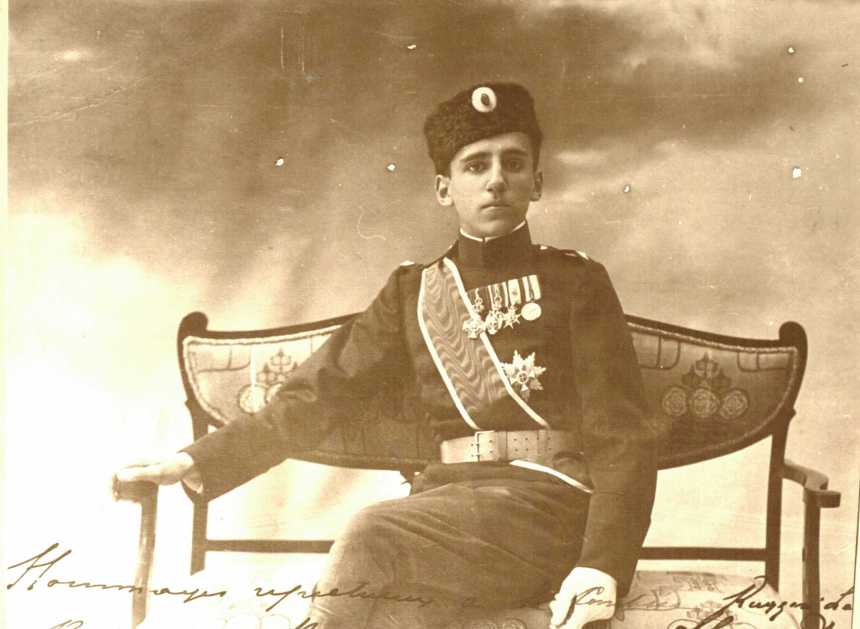
My sisters Rina and Lola were studying at a private Russian Institute and they were very satisfied with it; Paolo studied at the Military College in Rome and then in the Military Academy of Artillery at Turin and every summer he came to meet us in Fellandia; I and Giorgio II, studied at home with our governess Signorina Luisa Barsanti. Dad and Mom were very busy receiving diplomats and socialites and almost every evening they went out, returning very late at night. We also had dance parties for boys and sister dance parties for the young ladies. In our house there was organized a dancing class to which came our Russian cousins, friends, and acquaintances. The master of dance came with his “tapeur” (who played the piano) and we learned, other than good manners, how for example to greet, the manner of asking fo a dance, the way to say farewell, as well as the dances of the period. These were, citing the main ones, the Waltz, the Polka, the Pas d’Espagne, the Pas de Patineurs, the Mazurka, the Vinghierka and still others. Prince Alexander of Serbia participated in these classes as well, the second born of the House Karagheorgovich, who was completing his studies in the Corps of Pages of St. Petersburg. He was the nephew of Queen Elena because he was the son of her sister, and he had been recommended to my father by the queen herself. Through the death of his brother Giorgio, Alexander became then the Crown Prince and then King of Serbia; he found death, assassinated at Marseille in the course of an official visit to France together with the French President Barthou who accompanied him. There is a photo of him at home with a dedication offered to my mother: “A la Comtesse Ruggeri Laderchi homages respecteaux – Alexandre.”
Our stay in Russia coincided with the Russo-Japanese War, with some strikes and motions that were the warning signs of the Russian Revolution; they were also the last gleams of the Imperial Russian monarchy.
I remember that various times, and sometimes for long periods, we would be without electric light at home due to the operators striking; on those occasions we would bring out petroleum lamps with big green globes that gave the house an air of mystery; one day from the windows of our apartment that was on the ground floor, I saw a crowd of vociferous persons and then after a bit a great general fleeing while the cossacks passed like a hurricane with the “knut” (a type of cat-o’-nine-tails, but with seven) raised and hissing while it fell onto the shoulders of those who couldn’t dodge it; the street emptied in a flash, but on the ground remained numerous bodies of people struck now and then by the hooves of the horses.
When the Russo-Japanese war ended, I witnessed with the family a line of troops reduced by the way, in the streets of St. Petersburg. At home I then heard it said that the welcome made to the troops by the population had been deprived of every enthusiasm and very cold and the the atmosphere was one of a funeral; the Russo-Japanese War had finished badly for the Russian and the wound was open and burning.
At the beginning of the spring of every year, they had a place — in a vast plain near Zarskoie Selo, the summer residence of the Emperor and his family — a great military review. The emperor paraded the troops in a line, on horseback, with a large following of Grand-Dukes, of Generals, and Military Attachés of the various foreign nations. On a platform sat the relatives of the Emperor, personalities of the political and diplomatic world with the respective family members. At the moment of the extraction of the troops, the Emperor descended from his horse and ascended to the platform. The Parade ended with a choreographed and impressive charge by a dozen of the Cavalry Regiments against the Emperor’s platform; at the distance of a few meters, breaking the gallop the charge stopped and one single cry broke from all their chests: Hurrah! Hurrah!
It was during a pause of one of said reviews that my brother Paolino (Paolo II) was at an interview with the Emperor. Paolino, pupil of the Military College of Rome, was dressed in uniform for the occasion. The emperor, having noticed that unknown uniform worn by a boy (Paolino was 16) asked who he was, and having learned that he was the son of an Italian Military Adept, had him called up to the stage. The person of the Emperor and the hundreds of eyes turned to his stage would have intimidated and confused anyone, but instead Paolino was very ready of spirit and responding in French to the questions of the Emperor said, among other things, that only a few days before, when the news of the birth of the Tzarevich had reached home, the whole family had toasted to the health of the Italian Crown Prince (then Umberto II), who had also just been born, and of the Tzarevich and that everyone had shouted, “Evviva” [“cheers”]! This word was spoken by Paolino in Italian and the Emperor, moved by his referral to the Tzarevich, never forgot from then on to finish his toasts at official luncheons, turning to my father, and saying to him, “And now ‘Evviva’ since that’s what you used to say in your beautiful country.”


How I could say that Paolino was able to speak in French to the Emperor: in fact at home were spoken Italian and French without differentiation and often the discourse begun in one language would be finished in another. The English, German, and also French and Italian governesses, had taught us all each of these languages that were used during our conversations indiscriminately. When I returned to Italy at the end of 1908, and was 11 years old, I spoke well: Italian, French, English, German, and I expressed myself as well in Russian well enough, if not very much less well than the others. I retain that one of the determining elements of my military career and then of my industrial life, was indeed my knowledge of languages. Foreign languages must be studied from a young age if one wishes the language to remain present even if the opportunity to speak, as often happens, does not then present itself frequently and if one wishes to speak with good pronunciation.
Among the various governesses, the two I especially remember for having had an influence over us: one, the Italian, Signorina Luisa Barsanti, the other the English one, Miss Riley.
Signorina Luisa Barsanti came to our home in 1896 at the age of about 20 and there remained until her death came at Rome in 1948. She was a native of Borgo a Mozzano, Lucca, and having studied in a convent she was very religious, she was a teacher and had studied piano which she played scholastically without any musical inspiration. She gave to me and Giorgio I elementary instruction and also a little of grade school until, with our return to Italy, we were able to attend Italian schools. She dedicated her whole life to us; from Paolino, Rina, and Lola, to Cesare and Giorgio and then to Olga, Alessandro, and Nora. She did not elicit a great liking from us even if we all were, as is obvious, affectionate. This is because she was arid in her sentiments and devoid of enthusiasm. Under another point of view however she was a perfect, very disciplined governess, obsequious to my father’s orders and of absolute faithfulness. She was there with us in our happy days and those that were sorrowful, sharing our sufferings and our anxieties, just as our joys and, if she was not always tender and understanding with us, she still remains in our memory as a devoted, good, and profoundly upright person.
The English governess Miss Riley, Irish by birth, was instead very different. She stayed with us for a much shorter period that Signorina Luisa, because she most often accompanied us during the summers; then she came to visit us as well in Italy, but she left on us an influence perhaps greater than that of Signorina Luisa. That is because she had a fiery temperament and was passionate in her demonstrations; she was in sum, in few words, “living.” She found herself in Russia when the Revolution broke out; she was tortured because she hid — she who had been a governess of many families of high society — where the nobles had hidden their jewels, nor did she breathe a word. She succeeded in returning to her homeland with the English governor gave her a small pension for what she had suffered. We saw her again many years later in 1937 when I was a Military Attaché in London. She read my name in a newspaper on the occasion of a ceremony and wrote me to find out if I was “the little Cesarino that I had known in Russia”. I went to reveal myself with my car to the little town in which she lived, so she could spend the day with me. She was very old, but wanted me to sit in her armchair and she nestled at my feet on the carpet. Dear, good, intrepid woman, full of devotion and of abandon even after all those years had passed and we had lost sight of one another.
In Russia my sisters Rina and Lola met the men that they then respectively married. They made a very brilliant life, frequenting diplomatic balls and those of Russian society, and so they had a way to meet their future husbands. The first to may was Lola with Baron Leon von Rosen, in the diplomatic Russian service. The von Rosen family was of the Baltic high nobility. A branch remained in Russia when the Baltic Provinces were annexed by Russia; another branch moved to Germany assuming that nationality. The coat of arms carried on a blue field three red roses. Leon Rosen was a handsome man, cultured and distinguished; he played the cello very well and this was useful when, having emigrated abroad because of the Russian Revolution, he succeeded in overcoming the initial difficult financial period playing in orchestras. The wedding happened in St. Petersburg during the last year of our stay there, in the Orthodox rite which is among the most pompous. From the marriage were born two male children: Pawlik (Paolo IV), and Leon (Leo). Leon Rosen filled as a husband diplomatic posts in Monaco of Baviera and at Stockholm were he was Minister and where the Russian revolution took him by surprise.


In the meantime the health of my sister Lola began to arouse worries; this fact and the instability of her husband’s jobs, persuaded them to settle with their children in Vence, in the French Maritime Alps, where she died at a very young age in 1920. Lola was very beautiful and, especially, graceful and fine. She had a lively intelligence that she knew and wanted to put in the light. She wanted to stay with her children when, leaving them to take a curative trip, it was probably possible that she would get better or lengthen her life. She said that in the education of her children the most important thing was the education of the heart that only their mother could give them at that young age and she did not want to lose them instead. He tomb is in Vence. Her children Pawlik and Leon, actually occupy important positions of responsibility in French industry. Stateless persons until the end of the Second World War, they opted for French nationality where they had after all completed their studies and had always lived, and battled on the German front. They were able to adapt themselves as “self-made men” and they have something to be proud of. Pawlik, married, does not have children. Leon married Olga Stahovic and and has six children: four boys: Jean, Michel, Pierre, Leon, Paul and a girl named Marie Helene. They both live in France, in Paris.
Rina instead met her husband in Russia, but then married in Italy after we returned there. He was named Lischinzky and was of a Russian family, but of Polish origins. The family claimed the descendancy of the princely family of the same name that had a sovereign and one of their women was the wife of the king of France. The wedding took place in Italy in the Orthodox Church of Florence called by the Florentines the “Church of the Flasks” for the characteristic shape of its cupolas.
Another important event during Paolo Primo’s stay in Russia was the visit of Vittorio Emanuele III to the Tzar. Paolo Primo took part in the military mission that accompanied the king during the entire time his trip took place there and the King, at the side of the Tzar, participated in a great military review in his honor.
After the end of the mission of Military Attaché under the Royal Embassy of Italy in Russia and his return to Italy, Paolo Primo had the occasion to return to Russia for the offices of the Italian State two times in 1914 and 1916; then began the Russian Revolution and the new regime that cut out of that county that which for us held many memories and many places thing that tugged at our hearts.


 The Ruggeri-Laderchi Family