“In this last location there was reproduced as well the ‘steam-powered mill’ that Francesco Laderchi, for the first time in Italy, brought in from England and which was much spoken of and discussed during that period. In the public library, which has an extremely rich and important documentation reflecting the Laderchis and one of their coat of arms on one of the walls together with those of other noble families from Faenza, I read a tract by the very Zama Piero titled ‘The Windmill of Prada and the Count Francesco Laderchi’ which speaks widely of it. In brief it concerns this: Francesco Laderchi, with the intention of modernizing the milling of grain in Romagna, thought to bring the machinery of a steam-powered mill from England. He effected his end taking trips to England, he established the mode of transportation, he brought in some English specialists with the intention that they mount it in an adapted factory that he had built near his Villa in Prada, thinking to take advantage of the steam produced as a driving force from the boilers fed by water from the nearby Montone river. The business presented numerous and onerous difficulties alone in transporting the machinery, heavy and cumbersome, which eventually was done by way of sea to Genoa, being hauled (lit. ‘by pulling’) from Genoa to Piacenza, by barge on the River Po to Ferrara, and then still by barge back along the Reno until it reached the area of Faenza. A true feat! Having overcome these difficulties and opened the plant, Count Francesco then faced his largest, and probably in his time unforeseen, challenge: political hatred! He was an exponent of the ideas brought to Italy from the French Revolution. He was a Principal of the Roman Republic in his time, and the Restoration did not know how to forgive him for his past activity.
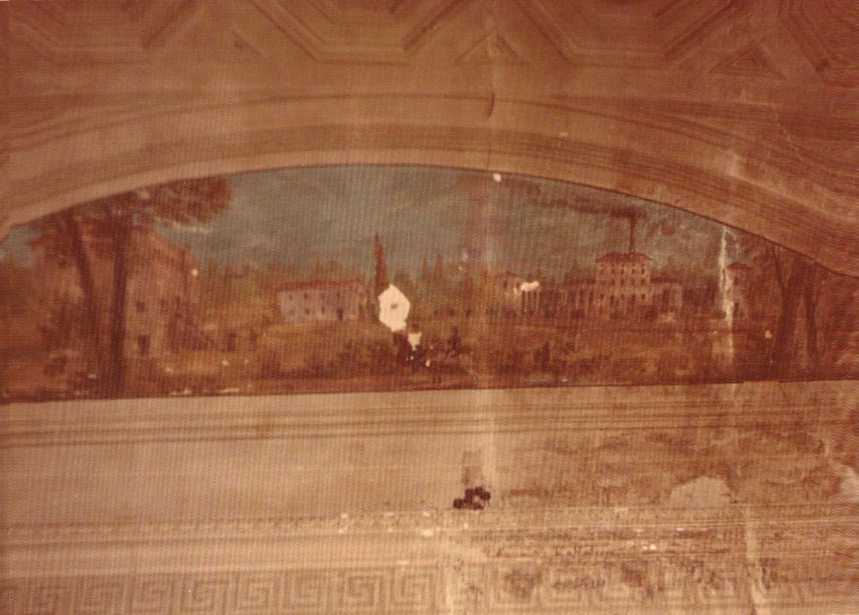
“The windmill was boycotted, the water from the Montone never had a flow adequate for the mill’s needs, and the populace that had to bring the grain to be milled in the new steam-powered mill were intimidated and suspicious of doing so, so that that windmill effectively never had a life of its own and never turned a profit. Falling into ruin within a brief period of years, it was destroyed, like the Villa Laderchi, in the early 1900’s. This is why the steam-powered mill was ‘cross and delight’ to Francesco Laderchi and it cost him an arm and a leg. [Literally, ‘it cost him an eye out of his head.’] As for Count Francesco, he died at Prada at only 45 years of age from an infection he contracted from the bite of a monkey he kept in the garden, sharing at many years’ distance the destiny of King George of Greece who also died from such a banal incident!
“I went to Prada on a type of pilgrimage as well as to see in the local cemetery if there was a Laderchi tomb. Nothing in the cemetery and nothing that records the Laderchis elsewhere. Sic transit gloria mundi! Nevertheless I couldn’t speak to the parish priest of the local church to see if he could give me some details on that to which many documents attest: That when it was prohibited to lay the dead to rest [inter them] in the church (as is the case in the church of St. Andrea delle Vigne in Faenza where the sepulcher of the “Gens Laderchis” is), they were buried nearby in Prada (1). It can be accessed in Prada, which is a little center, by the Ravegnana street; about 20 km from Faenza a rolling stock directs you toward the Montone; a few kilometers from the crossroads, there is Prada.”
 The Ruggeri-Laderchi Family