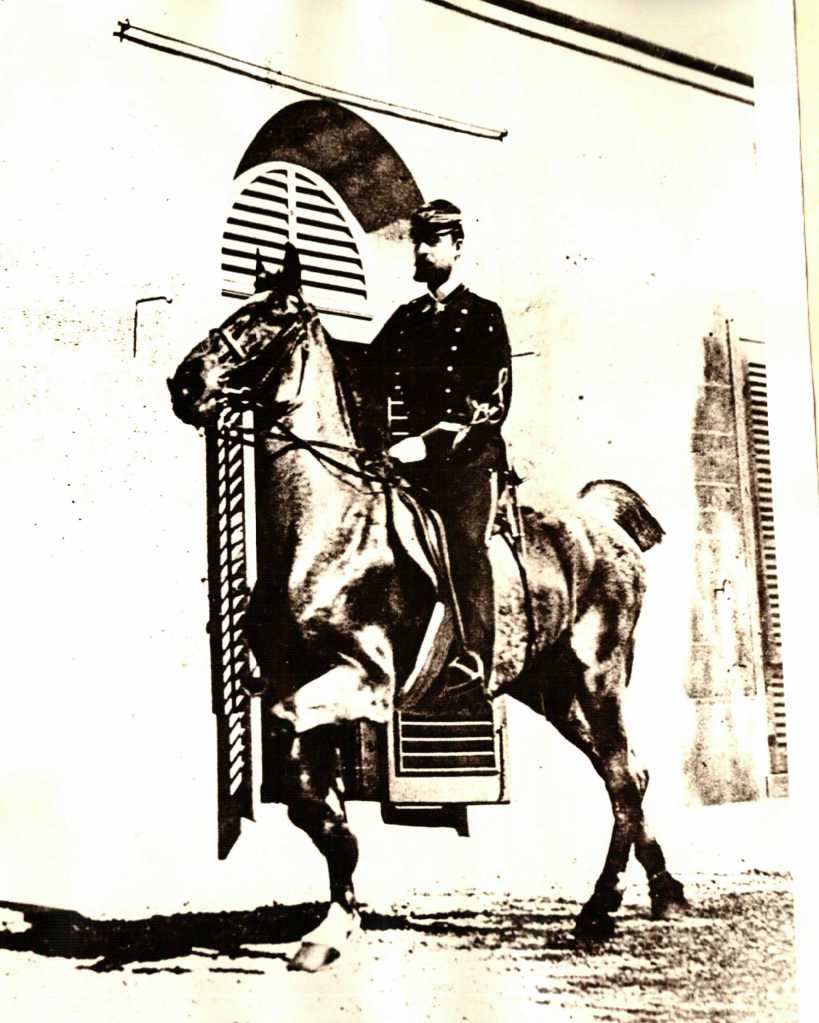
The Family of Paolo Primo
On February 12, 1862, Paolo was born in Bergamo, first child to Cesare Ruggeri — voluntary official for Piedmont in 1859, born in 1839, died in 1908 — and to Countess Rina Laderchi, born in 1838, died 1898.
According to tradition he was given the name Paolo after his paternal grandfather; the second son was named Carlo, after Rina’s father. The two daughters who followed were named Teresa and Giulia.
The counting of the various Paolos in the family begins with Paolo di Cesare, and has today reached Paolo V.
Paolo di Cesare was therefore Paolo Primo (Paolo the First) and the founder of the Ruggeri-Laderchi Family, not only because he was the first Ruggeri-Laderchi, but also because as a founder, he had character and vision.
I will write broadly about his life, which was particularly dense, varied, and glorious, in another book titled Life of Paolo the First; here it is enough to touch on the fact that his education came in difficult circumstances, specially imparted by his mother Rina, a strong-willed woman of notable intelligence, in the years of his infancy and tempered by the forges of the Men and Soldiers first at the Military College of Milan, then of the Royal Military Academy of Artillery and Genius in Turin.
Paolo’s father: Cesare, volunteer in the campaign of 1859, therefrom Garabaldian Officer, served in the Royal army in 1866, taking part in this campaign, therefrom the siege of Gaeta and the battle against the brigandage in Calabria.
His military career was cut short when he achieved the status of Colonel, by way of grave arthritis that he had contracted in the service that practically immobilized him while he was still quite young. He found relief during the sadness of his immobility in literature, but he was also greatly helped by his fervid imagination, which allowed him to effect journeys of which, notwithstanding they were imaginary, he knew all the details.
He lived, after the death of his wife in 1898, with his daughter Teresa, spouse of the doctor Bosi who practiced his profession in the Tredozio area, a little town in the Florence-Faenza region; after many years of sedentary life he wanted to take a trip (the briefest of those he planned) to visit his son Carlo, a Major in the Army, serving in Foggia. And at Foggia he died only a few days after his arrival. To Paolo Primo, who had rushed to his bedside and asked, “Papa, how is it going?” he responded wittily, “As you can see … I’m going.”
Rina Laderchi, very beautiful, cultured, volitional, and intelligent, was the daughter of the engineer Carlo Laderchi and granddaughter of attorneys and jurists who constituted a highly esteemed cultural and patriotic center where they lived in Ferrara, counting among the others the friendship of Silvio Pellico and of Cesare Cantù.
She was slightly lame due to a fall when she was little; this induced her to walk as if she grazed the ground, transforming in this way through her own will a defect into a mincing trademark. She followed her husband intrepidly with their children to the unhappy garrisons of Calabria, often traveling on the back of a donkey with her baby Paolo Primo in her arms. She died in 1898.
Cesare and Rina Ruggeri are laid to rest in the Cemetery of San Miniato in Florence.
 The Ruggeri-Laderchi Family