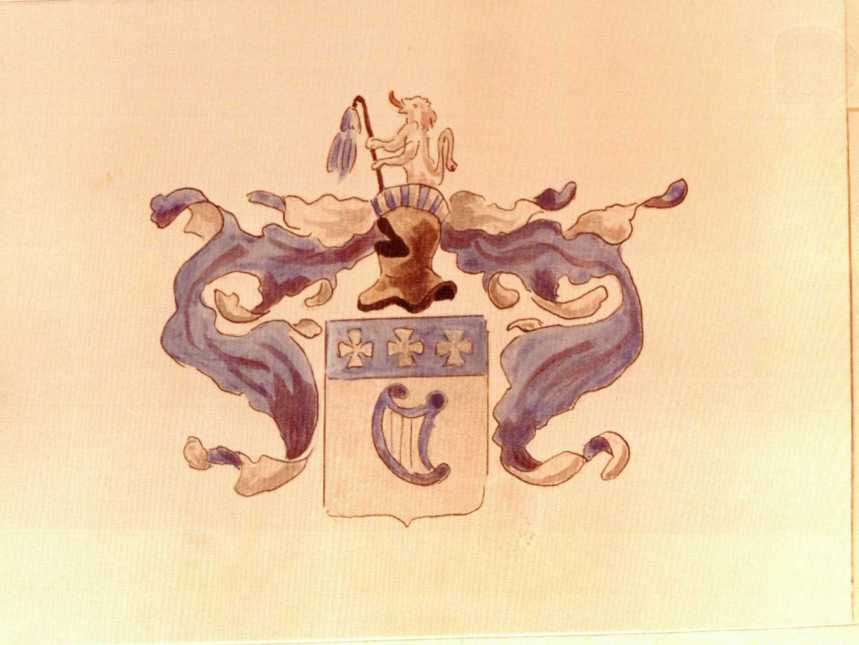
In 1763 Mark Feodorovich Poltoratsky was made noble for the services rendered by him in the field of music in the vocal philharmonic of the Imperial Court. At the same time he was lavished with large estates in the south of Russia.
Coat of arms: A lyre on a silver field surmounted by a blue band with three foreshortened crosses in silver.
Mark Poltoratsky became known for his splendid voice and was invited to the school of singing in the province and therefore at St. Petersburg. Noticed for his comeliness and his voice by the Emperor Elisabetta, he was named “Master of the Chamber” and chorister of the “Imperial Chapel.” With the passing of years he ascended to a level of importance becoming an intimate of the Imperial Court and invited often to the Imperial table.
Having married the daughter of a rich merchant he became a widower almost immediately and from his wife he inherited vast estates. He married a second time to a young woman of 17, Agafhoclea Shishkov who was an extraordinary woman. Not only did she give her husband 11 children, but she was also a very precise, energetic, and exceptionally able administrator. But she had a negative side and this had the shape of sadistic cruelty; she for example quieted her nerves with the screams of the servants who frustrated her.
Involved from her youth in a boring business for having rashly made use of her signature on documents that were then subject to a judicial case, she swore that she had never personally signed the documents and in fact she was assisted by her secretary with the contracts, to whom she had delegated her signature. For all that has been said about her above many believed that she was illiterate.
Next to death, she made public amends in the square of her town in the presence of her peasantry, that amounted to a good 1,300.
Her daughter, Elisabetta Poltoratsky, inherited part of the lavish fortune that she had carried in dowry to her husband Alessandro Olenine, with whom she shared scientific and artistic interests. Of them it has already been spoken in the description of the Olenine family. Their daughter Anna, a beauty of that period, and inspirer of many poems of Pushkin, married Theodoro Andrault de Langeron.


The Poltoratskys’ house at Gruizny, built on the design of a noted Italian architect, was splendid and rich with imaginative ornamental details from the period.
The property named Priotino had a decisively Italian aspect and, an exceptional thing for that period, particularly in the provinces, was constructed of stone and bricks with a tiled roof in the Roman style, canopies over the windows, and other ornaments of the same material.
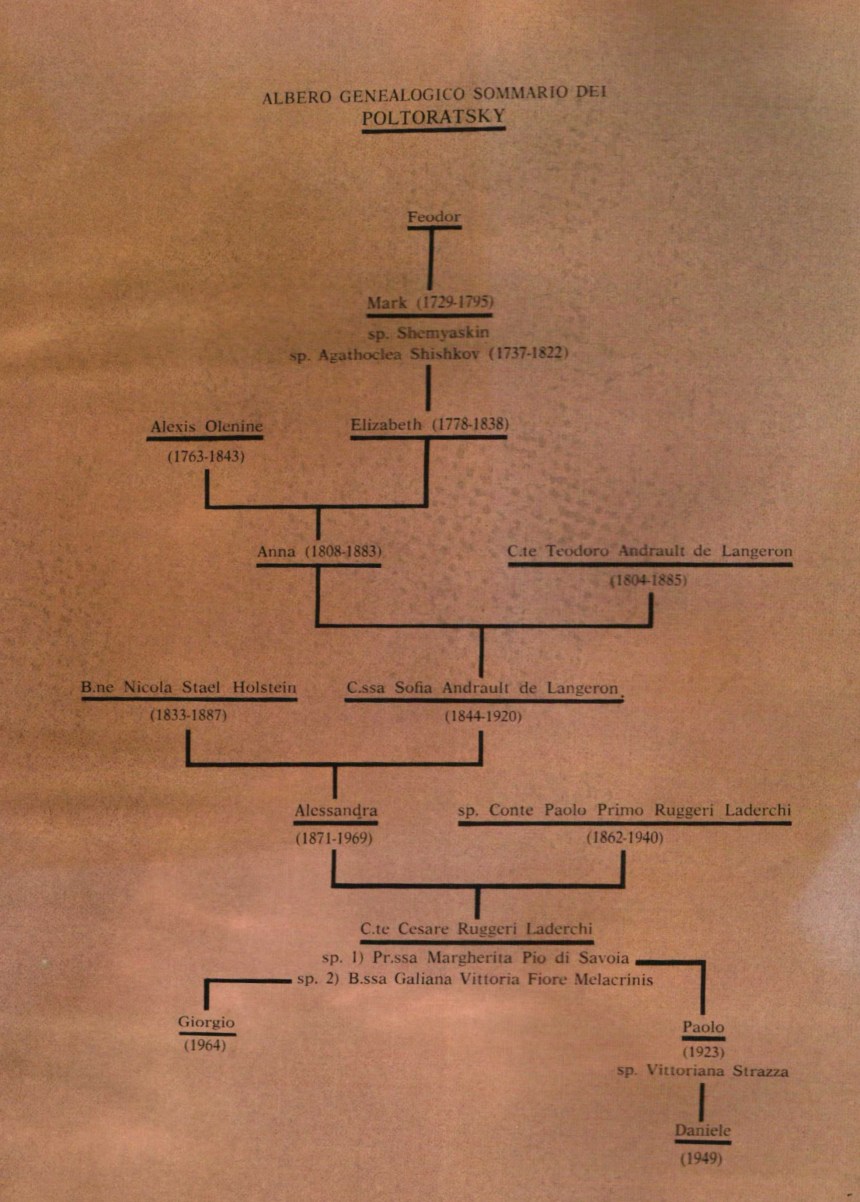
 The Ruggeri-Laderchi Family